

About care
Please take good care of it on a regular basis.
- Do not pull out the crown to wash the watch.
- Please make sure to wipe away moisture, sweat, and dirt frequently with a soft cloth.
- After soaking in seawater, be sure to rinse thoroughly with fresh water and then wipe dry. When doing so, avoid pouring water directly from the tap; instead, fill a container with water and then rinse.
Please refrain from using items that are "not waterproof" or "water-resistant for everyday use."
Please check the caliber number and water resistance rating.
- Please rotate the crown occasionally.
- To prevent the crown from rusting, rotate it occasionally.
The same applies to screw-lock crowns.
Quartz vs. Mechanical. What's the difference?
Let me give you a relatable example.
A quartz watch that we are all familiar with on a daily basis.
This is, so to speak, like a computer-controlled airplane.
Using batteries, ICs, and crystals, it generates extremely accurate time electrically.
While slight errors may occur during use, they are so small that they are barely noticeable in our daily lives.
If quartz watches are like airplanes, then mechanical watches are more like bicycles, wouldn't you say?
All the parts work together mechanically to keep time.
Therefore, it is greatly influenced by the surrounding environment.
In general, watches tend to run slower in hot weather, and their accuracy becomes unstable when there is insufficient power (insufficient winding of the mainspring).
The accuracy of a watch changes when its position (orientation) changes.
That error can sometimes become large enough to be noticeable in our daily lives
Mechanical accuracy is measured in daily variation.
Actual measured values of how fast or slow the clock is per day.
That's called sun exposure.
The accuracy of mechanical watches is usually expressed in terms of daily variation.
The accuracy of mechanical watches can vary slightly from day to day due to differences in usage conditions and external environmental factors.
Therefore, you cannot judge the accuracy of a clock by looking at how fast or slow it is for just one day.
It's correct to observe the progress/delay over a period of about a week to ten days and make a judgment based on the average value.
Incidentally, the accuracy of quartz watches is generally measured in terms of monthly or yearly deviation. The total error over a month or a year is referred to as the accuracy of a quartz watch.
Static accuracy and mobile accuracy
The accuracy of a mechanical watch varies depending on factors such as the amount of winding of the mainspring, temperature, and position (the orientation of the watch).
Therefore, in order to fairly demonstrate the capabilities of the mechanical watch, unaffected by environmental factors, the movement itself, before being assembled into a case, is measured for gain or loss over several days in a controlled environment.
We refer to that measured value as "static accuracy."
Both the international standard ISO3159 and the Grand Seiko standard certification * specify static accuracy values.
For more information about Grand Seiko certification standards, please read about Grand Seiko standards.
These figures represent data measured in an artificially controlled environment to fairly evaluate and display the performance of mechanical watches without being affected by environmental changes. Therefore, they differ from the actual accuracy you will experience when using the watch.
The precision of a mechanical watch changes subtly from day to day due to differences in the environment.
This is almost like a living thing, and it's part of its charm.
The accuracy of this product is approximately within the range of -1 to +8 seconds per day. If it exceeds this range, we recommend adjustment. To perform the accuracy adjustment as correctly as possible, your usage conditions and the specific amount of gain/lagging at that time are important information. Therefore, when making a request, please also provide the following information.
- Average daily progress/delay over a 7-10 day period of use
Example: "Average + 11 seconds" - Approximate daily wearing time during the above usage period
Example: "Approximately 10 hours" - The orientation of a watch when it is taken off your wrist and placed down.
Examples: "Place the watch face up flat," "Place the watch upright with the crown facing upwards," etc.
Rule #1 for enjoying your mechanical watch for a long time
Wind the spring at a set time.
Just as there are rules for everything, there are also rules for winding a spring.
Is this the first time you've heard of it?
But please remember this.
The mainspring is the energy source for a mechanical watch.
When fully wound, the watch can supply the most stable energy to each component, resulting in the most stable accuracy.
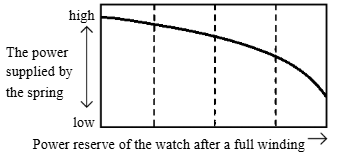
If you feel that the accuracy of your automatic watch isn't stable, turn the crown to wind the mainspring.
When you spend a lot of time doing desk work and not getting much exercise, the spring in your toy won't wind up completely.
For manual winding watches, turn the crown at the same time every day to fully wind the mainspring.
To maintain optimal accuracy, wind the mainspring once a day at a set time.
Please try to follow this rule as much as possible.
For example, you could designate specific times, such as when you wake up or during your lunch break, to wind the spring.
Rule #2 for enjoying your mechanical watch for a long time
The clock should be placed like this.
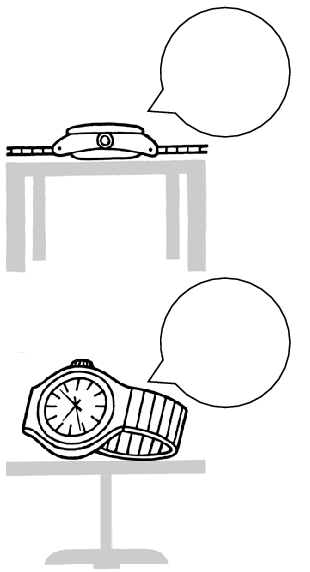
During a 24-hour day, you'll likely take your watch off your wrist for almost half the time. "Portable accuracy" includes the accuracy of a watch during that period.
A mechanical watch removed from the wrist.
So, in what position should we place it?
Mechanical watches will run faster or slower depending on their position (orientation).
Some areas are moving forward, while others are not.
When you take the watch off your wrist at night, such as while you sleep, try leaving it in various orientations for 7-8 hours, such as with the dial facing up or the crown facing up, to find the position that minimizes the timekeeping gain or loss that occurs when you are wearing it on your wrist.
Rule #3 for enjoying your mechanical watch for a long time
The accuracy also changes depending on the temperature.
It's made by wrapping around a thin metal strand, about 0.1 mm thick, as thin as a strand of hair.
That's the balance spring, the key to the accuracy of a mechanical watch.
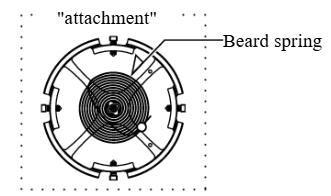
The inherent property of metals to expand and contract with temperature changes also applies to hairsprings, affecting the accuracy of a watch.
In other words, in hot weather, the hairsprings tend to grow and lag behind.
In cold weather, the hairspring tends to contract and move forward more easily.
Rule #4 for enjoying your mechanical watch for a long time
Keep away from areas with strong magnetic fields.
When you take your watch off, do you place it next to your cell phone, or on top of your computer or TV?
Are you keeping it in your bag along with your cell phone?
Watches don't like magnetism.
Due to the influence of magnetism, movement may be affected by the magnetic field, sometimes moving forward and sometimes slowing down.
To ensure your mechanical watch maintains its accuracy, it's important to keep it away from magnetic fields for extended periods.
The speaker sections of mobile phones, televisions, and computers, in particular, emit strong magnetic fields.
In addition, there are many things in our daily lives that emit strong magnetic forces, such as magnetic necklaces, handbag clasps, and the magnetic parts of refrigerators.
please note.
Rule #5 for enjoying your mechanical watch for a long time
Avoid strong impacts.
Whether it's golf, tennis, or baseball
When participating in sports that involve strong impacts to the wrist, please remove your mechanical watch.
There is a reason.
For example, at the moment of impact in golf, the force with which the club hits the ball is approximately 1 ton.
That shock is transmitted to your wrist and affects the tiny components inside the mechanical watch.
Sometimes, this can deform or even break the parts.
A good shot can be a bad shock for a watch.
Rule #6 for enjoying your mechanical watch for a long time
Overhaul every 3-4 years.
Love comes every 3-4 years.
This is about overhauling.
Even mechanical watches that don't require battery replacement still need regular maintenance.
Please have it disassembled, inspected, and cleaned every 3 to 4 years.
This is a watch that, once you start wearing it, will never stop.
Furthermore, because mechanical watches transmit more force to their gears compared to quartz watches, there may be areas where parts are worn out, or where the lubricant has dried up or is insufficient.
In particular, the first 3 to 4 years of use are a period when each part needs time to settle in, and a lot of wear debris is produced as the parts rub against each other.
The first overhaul determines the entire life cycle of a mechanical watch.
Please remember to have it overhauled every 3-4 years.
You could say it's a love for watches.
- The accuracy of a mechanical watch when worn varies depending on each customer's usage conditions (such as the amount of winding due to daily arm movement, temperature, and position [orientation of the watch]). Therefore, the accuracy when actually worn by the customer may differ from the values specified in the Grand Seiko standards.
- For customers using mobile devices, the accuracy is approximately within the range of -1 to +8 seconds per day. To accurately assess the accuracy of your watch while wearing it, please observe its accuracy for 7 to 10 days under normal usage conditions, rather than just for one day. If the average daily value exceeds the above guideline range, we recommend adjustment. (For more details, please refer to the Grand Seiko specifications .)
- The included Grand Seiko Standard Certification Certificate proves that the movement, in its standalone state before being assembled into the case, has passed the Grand Seiko Standard Certification based on actual measurements taken under artificially controlled conditions within the manufacturing plant. Lost cards cannot be reissued, nor can they be reissued after repair or adjustment.
caveat
This indicates that there is a risk of serious consequences, such as severe injury, if the product is handled incorrectly.
Please discontinue use in the following cases:
- If the watch body or band becomes sharp due to corrosion, etc.
- If the band pin pops out
*Please contact the store where you purchased the product or our customer service department immediately.
Keep the clock body and parts out of reach of infants and young children.
There is a risk that infants and young children may swallow the parts.
If swallowed, it may be harmful to your health, so please consult a doctor immediately.
Note
- Areas where volatile chemicals are emitted (such as nail polish remover, other cosmetics, insect repellents, paint thinner, etc.)
- Places where temperatures remain outside the 5°C to 35°C range for extended periods.
- Places affected by magnetism or static electricity
- Places with strong vibrations
- High humidity
- dusty places
If you experience an allergic reaction or rash
Stop using the watch immediately and consult a dermatologist or other specialist.
Other precautions
- Adjusting metal watch bands requires specialized knowledge and skills, so please have it done at the store where you purchased it.
Attempting to do it yourself may result in injury to your hands or fingers, or loss of parts. - Do not disassemble or modify the product.
- Please keep the watch out of reach of infants and young children. It may cause injury or allergic reactions.
- For pendant watches and cord watches, please handle the cord or chain with care. It may injure clothing, hands, or neck, or even cause strangulation.
- Please be aware that if you remove your watch and leave it as is, the case back may rub against the band or clasp, potentially scratching the surface of the case back. If you remove your watch, we recommend placing a soft cloth or similar material between it and the case back.
About Caliber
This is a four-digit number that represents the model of the movement (the mechanical part of the watch). Grand Seiko watches are equipped with exclusive movements, and mechanical calibers are represented by four-digit numbers starting with 9S, Spring Drive calibers by 9R, and quartz calibers by 9F, 8J, or 4J.
How to check
The four-digit model number inscribed on the case back is the caliber number.
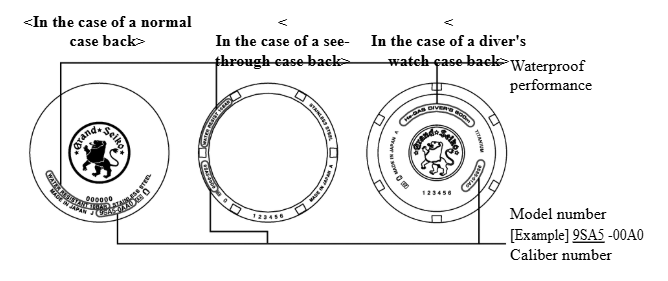
*The image above is an example and may differ from the actual watch you purchase.
Regarding waterproof performance
Please check the water resistance rating of your purchased watch in the table below before use.
| Case back display | Waterproof performance | Instructions for use |
|---|---|---|
| No waterproof rating indicated. | It is not waterproof. | Do not use if it gets wet or if you sweat a lot. |
| WATER RESISTANT | It is water-resistant for everyday use. |
It can be used in everyday environments where it might get splashed with water. ⚠️ caveat Do not use for swimming. |
| WATER RESISTANT 5 BAR |
It has enhanced water resistance for everyday use and is water-resistant to 5 atmospheres. | It can be used for sports such as swimming. |
| Water Resistant 10 (20) Bar |
It has enhanced water resistance for everyday use and is water-resistant to 10 (20) atmospheres. | It can be used for skin diving without using air tanks. |
| DIVER'S WATCH 200m or AIR DIVER'S 200m | It's waterproof for air diving and is water-resistant up to 200 meters. | It can be used for scuba diving using air tanks. |
| DIVER'S WATCH 600m FOR SATURATION DIVING or The GAS DIVER'S 600m | It's waterproof for saturation diving and is water-resistant up to 600 meters. | It can be used for saturation diving using helium gas. |
*The display location and design may vary depending on the model.
Note
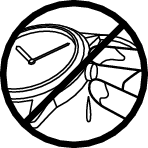
Do not operate the crown or buttons while the watch is wet.
Moisture can get inside the watch.
If condensation or water droplets appear on the inside of the glass and do not disappear for an extended period, it indicates a waterproofing failure.
Please contact the store where you purchased the product or our customer service center as soon as possible.
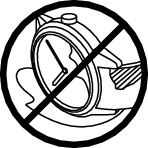
Avoid leaving water, sweat, or dirt on the product.
Even waterproof watches can become unwaterproof due to deterioration of the glass's adhesive surface and gaskets, or rusting of the stainless steel.

Please avoid using this product while bathing or using a sauna.
Steam, soap, and components from hot springs can accelerate the deterioration of waterproofing performance.
If the performance specification is "WATER RESISTANT"
caveat
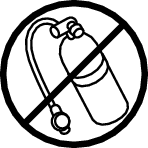
Never use this watch for scuba diving or saturation diving.
This watch has not undergone the rigorous testing required for scuba diving and saturation diving, which are demanding environments. Please use a dedicated diver's watch.
Note
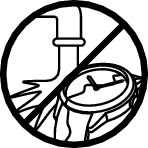
Please avoid pouring water directly from the tap.
Tap water has very high water pressure, which can cause even watches with enhanced water resistance for everyday use to become unwaterproof.
9SA5
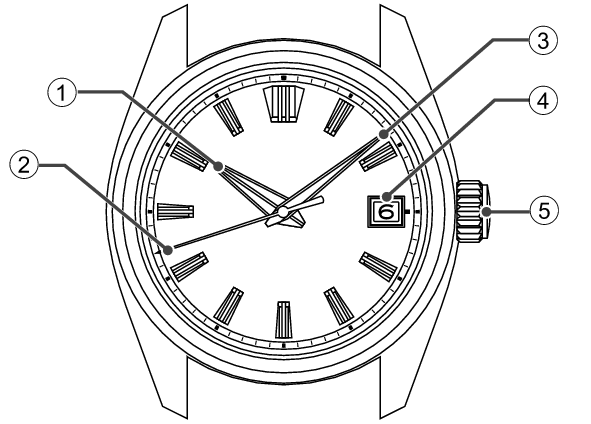
- hour hand
- second hand
- minute hand
- date
- crown
How to set the time and date
9SC5
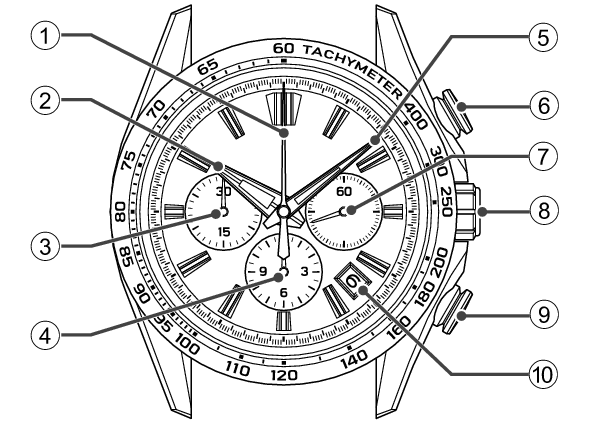
- Center chronograph hand (seconds)
- hour hand
- Chronograph hand (minutes)
- Chronograph hand (hours)
- minute hand
- Start/Stop button
- small second hand
- crown
About the crown - Reset button
- date
How to set the time and date
About the chronograph (9SC5)
There are two types of crowns: regular ones and those with a locking mechanism. Please check the type of crown on your watch.
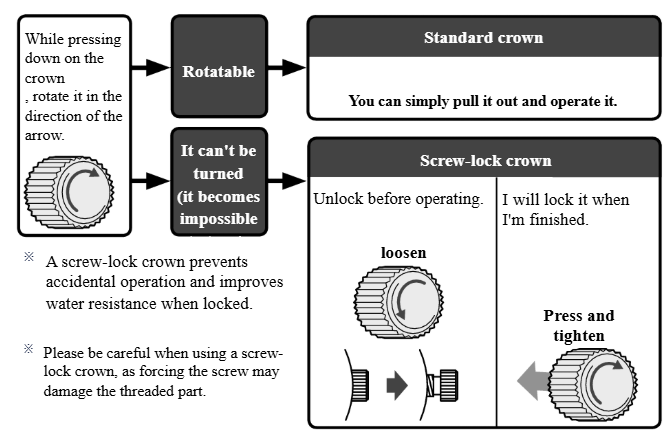
*Please rotate the crown occasionally. (Regarding maintenance)
To prevent accidental operation and improve water resistance, the crown can be locked with a screw when not in use.
- Please unlock the crown before operating it.
- Please lock the device when you are finished.
How to unlock it
Turn the crown to the left (towards the 6 o'clock position).
The screw will loosen, and you will be able to operate the crown.
[How to lock]
Gently press the crown against the watch body and rotate it to the right (towards the 12 o'clock position) until it stops.
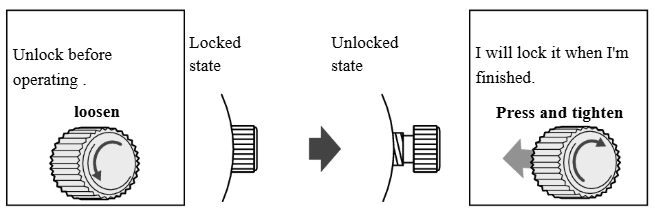
*When locking, please turn slowly while pressing, paying attention to how the screws engage. Forcing it may damage the screw part (case), so please be careful.
How to wind a spring
- This watch is an automatic mechanical watch (with manual winding capability).
- The mainspring of a watch naturally winds up with normal arm movements while the watch is worn on the wrist. It can also be wound by turning the crown.
- When using a stopped watch, shaking it will start it, but please wind the mainspring fully by turning the crown, set the date and time, and then wear it on your wrist. When winding the mainspring, turn the crown slowly to the right (towards 12 o'clock) with the crown in the 0 position. Note that the crown will spin freely if turned to the left (towards 6 o'clock).
- The watch can be fully wound by turning the crown approximately 60 times. The mainspring is designed to slip when fully wound. While there is no risk of breaking the mainspring, please refrain from excessive winding.
- Insufficient winding of the mainspring can cause the watch to run fast or slow, so we recommend wearing it for at least 10 hours a day. Also, if you are not wearing the watch on your wrist, please wind the mainspring fully by turning the crown at a set time each day.
Note
- Do not adjust the date when the time display shows between 9 PM and 1 AM (or between 8 PM and 2 AM for the 9SC5).
- If you change the date during this time, the date may not change even the next day, or it may cause a malfunction.
- If you want to set the time between 7 PM and 1 AM, first turn the crown back to 6 PM, then rotate the crown counterclockwise (towards 6 o'clock) so that the hour hand moves forward.
- Due to the mechanism of the gear train, when setting the time on a mechanical watch, first set the hands slightly behind the correct time, and then advance them to the correct time.
How to set the time and date
This watch has a date display function. The date advances by one day every 24 hours.
The date is set to be sent around "midnight". Therefore, if you mistakenly set the time to AM or PM, the date will change around noon.
1. Pull the crown out to the first position.
(If it's a screw-lock type, please unlock it.)
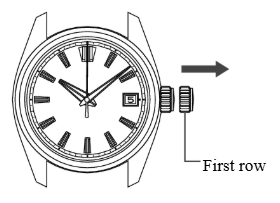
2. On the 9SA5, you can adjust the date by turning the crown to the left (towards 6 o'clock), and on the 9SC5, by turning it to the right (towards 12 o'clock).
First, set the date to the day before the day you want to match.
【example】
If the date to be adjusted is the 6th, adjust it to the 5th.
3. Pull the crown out to the second click. Pull it out when the second hand reaches the "12 o'clock" position. (The second hand will stop.)
Turn the crown counterclockwise (towards 6 o'clock) so that the hands move forward until the date displays today's date. Once the date changes, it's "AM". Turn it forward further to set the current time.
4. The watch will start when you push the crown all the way to the 0th position.
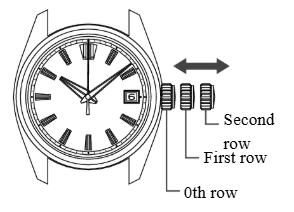
Note
If it's a screw-lock crown, be sure to tighten it back to its original position.
Regarding date corrections at the end of the month
Date adjustments are necessary for February (which has 28 days, or 29 in a leap year) and for months with fewer days (which have 30 days).
【example】
If you correct the date on the morning of the 1st of the month following a short month
The watch is displaying "31st" instead of "1st". Pull the crown out to the first position. Rotate the crown to set the date to "1st", then push the crown back in.
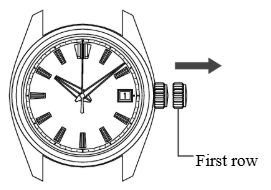
Note
If it's a screw-lock crown, be sure to tighten it back to its original position.